
November 9, 2026
Mercy, Hold the Line
On the intertwined legacies of Hazel Scott, Mary Lou Williams, and Geri Allen

Geri Allen, Hazel Scott, Mary Lou Williams. Sophie Douala
I
“Wasn’t Hazel Scott lovely?” Mama texts me in spring, apropos of nothing and everything.
“Lovely,” and for that matter “love,” make few appearances in my mother’s discourse. The word and its variants are reserved for the most sacred praise, marking adoration of a comprehensive beauty comprised of grace, balance, and justice. Perhaps she has just come across pictures of my sister and me playing violin as children, the looks of ferocious concentration on our small faces, and been reminded of Scott’s rendition of Liszt’s “Hungarian Rhapsody 2.” In this performance for World War II soldiers, Scott offers an intense stillness and control to its classical beginning, though there is a flicker in her body that prefaces the head-nodding groove she has planned around the corner. Or maybe Mama’s recalling that iconic scene from Scott’s 1943 Hollywood debut, Something to Shout About, in which she glides into the room accompanied by her gorgeous band and entourage robed in plump white fur. When stopped and asked who she’s there to see, Scott turns on a cloud, brings a gentle hand to the frame of her scarf, and smiles sunrays: “I’m Hazel Scott. We’re here for the audition.”
Or perhaps Mama has simply remembered one of the many clips of Scott singing to Parisian audiences in French, the language my mother took up in college, and the ease with which Scott inhabits it in a country that offers the opportunity for some limited comfort and capital in exile.
The Trinidadian classical and jazz genius Hazel Scott is a perennial presence in Mama’s and my conversations. I imagine she resides in some throne room in my mother’s heart alongside Dame Shirley Bassey, whose fierce conjurer’s voice bewitched her as a young teenager in the segregated balcony of the Orpheum Theatre in 1960s Memphis. Like Bassey, Scott is a line through things we need sound and spirit to say: how lovely it is to witness each other in places where we are not expected to be, and to make our presence there seem effortless; how we love to see each other acting “right” and then turning the corner and cutting up as only we can, putting our own magic on the usual and making it marvelous and almost unknowable; how lovely it is to love each other enough, in the loudest of quiets, to not only survive but to enjoy and create. My mother and I, we are women who sing the praise songs of other women, living and passed on, flowers at the ready on our tongues. We know the significance of holding this line across time.
It might be that the beloved Scott, daughter of classically trained pianist and teacher Alma Long Scott, was inevitable, marching forth as she did from such an educator mother in such a house ripe with sound. Born in Port of Spain in 1920 and raised in Harlem, Scott certainly absorbed lessons from her mother, a lovely bandleader in her own right. Maybe the syncretic Black Atlantic music forms—African, European, and Caribbean—pulsing in her neighborhood were inescapable sonic inspiration. Interwar Harlem must have inculcated a penchant toward jazz and fight. But perhaps baby Hazel arrived with her very own charge to hold the line, to carry it on, to ensure it could not be broken.
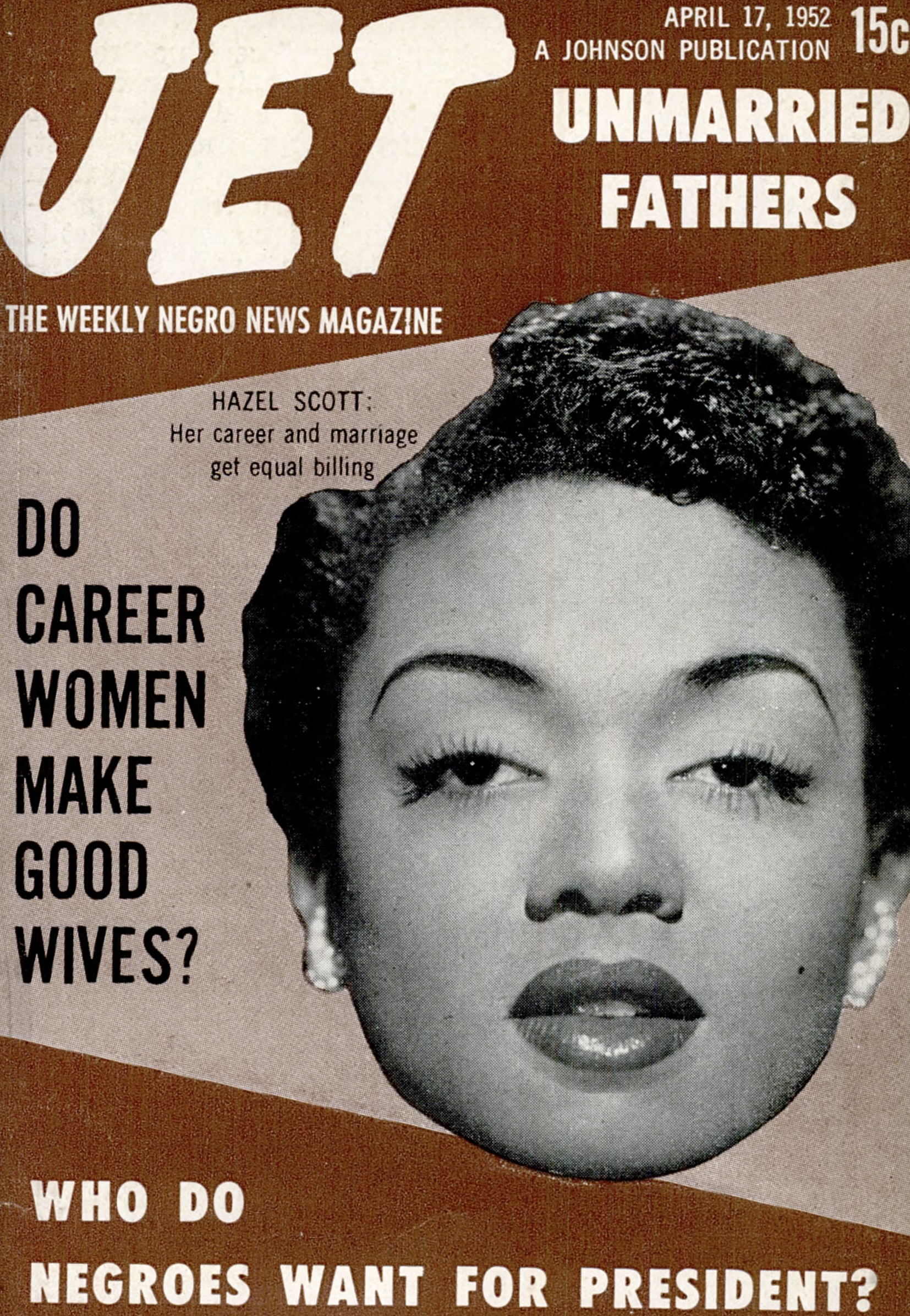
Like no other before or after, Scott could hold at once the lineage of Western classical music, the Liszt and Rachmaninoff and Bach, and the boogie-woogie or swing, whichever the left hand’s mood summoned. She was moreover an innovator in the Black classical music forms of blues, jazz, and rock n’ roll. Take her composition “Blues in B Flat,” the second track on Her Second Album of Piano Solos with Drum Acc. (1942), in which the piano functions as at once a walking upright bass, a trumpet, a juke, plus some footwork and Sister Rosetta Tharpe’s electric guitar. Laid right on top of it all is a humming voice, likely Scott’s own, almost discernible on various lines in the jam. That the album advertises “drums accompaniment” in the title is a bit of signifying. The drums, played by an uncredited J.C. Heard, appear on the lead composition, “Hazel’s Boogie Woogie.” But the snare and hi-hat melt under the rush of the main piano rhythm and its boogie-woogie bass. On “Blues in B Flat,” there is no drum accompaniment; it’s as if Scott is declaring that under her fingers, the piano itself is a drum.
The remaining pieces, mostly from popular musicals, are revisions both tender and theatrical of the original Gershwin, Ruby, and Youmans. These recordings anticipate Relaxed Piano Moods and 'Round Midnight, her highly regarded albums from the 1950s, wherein her skill as both composer and virtuosic interpreter of others’ compositions is on spectacular display.
Scott’s virtuosity was rivaled only by her conviction — and perhaps the concomitant amount of stubbornness and pride necessary to sustain a fervent belief in beauty’s power, as W.E.B. Du Bois had put it, “to set the world right.” She certainly paid the cost for it, as women with nerve are often made to do. She was blacklisted in Hollywood for advocating for Black women’s dignity and loveliness, and the U.S. government called her to testify before the House Un-American Activities Committee, which she did, fiercely, in 1950. In that hearing, in addition to tendering a detailed written statement that she requests to be entered into the record, in its entirety, Scott peppers the committee with questions of her own. “If any committee, an official committee, lists me as having two heads, does that make me have two heads, and does that give Red Channels a right to publish I have two heads?” Sheer, lovely discursive work in an impossible milieu.
Like other Black artists in the McCarthy period, Scott enjoyed some reprieve and success in Europe. But this would not last forever. By the mid-1960s, the effects of exile, changing musical tastes, illness, and injury, including a broken hand, piled upon her. For years Scott’s legitimate fears left her in immigration limbo, afraid to attempt a return to the United States. Colleagues and friends who saw her in Paris during her later years there, including Nina Simone, wrote to urge her return—but Scott often pointedly countered that it was not at all that simple.
II
It was in 1954, during one of Scott’s first summers in Paris, where she’d come to work and perform to glorious reception, that her contemporary and mentor Mary Lou Williams abruptly left a stage mid-performance.
Everybody knows the story of Williams, the bebop innovator, big band leader, mentor, composer, and arranger to all the names, rising stung from the piano in the middle of a performance at Le Boeuf sur le Toit. She was overcome by a charge — a call for fervent, daily prayer, for herself and everyone else. Her grief and exhaustion, the recent and prophesized losses of close jazz friends and mentees, and the demands of her career had extracted their toll on her body and spirit. They were also the fault lines around which new foundational geometries, new spiritual lines, took shape.

A decade younger than Williams, Scott had overlapped with the composer and pianist at Café Society back in New York. Scott sought Williams out when she heard the news of her walkoff, which must have spread viciously even, or perhaps especially, in Paris. It was Scott who eventually arranged for Williams to return home to Harlem, where after a period of inwardness and seclusion (save for church and close friends), she would start her mission work to support the hearts, minds, and spirits of jazz musicians.
In those early days of retreat, Scott offered Williams the Book of Psalms as a balm. She suggested Williams heed the call to pray. And so Williams did. Over the coming years, the women would exchange letters about music, about the industry, about spirituality. And in a period of illness and calamity for both of them, Williams wrote to Scott: “Pray! Pray! Ask for forgiveness! You’re blocked. Pray for me. I, too, am sick.” Perhaps, in other words, sister, hold the line.
Williams had been born with a veil and, as she reported, had been psychic all her life. Like Scott, her piano gifts manifested early under the tutelage of a mother-teacher. But the need to make money for her family, as well as the physical violence she suffered in and beyond her home, drove her out into the world, where often other violences awaited. She played around her “Up South” hometown of Pittsburgh, palliating racists with her unusual piano talent, her ear. Williams was on the road before she was a teenager. By the time of that evening in Paris, she had been a prodigy, an exile in and beyond her home, a laborer in an exploitative industry, a sufferer, and a witness to the suffering of others for nearly forty-four years. Williams’ second sight, her two-headedness, demanded her full attention. That night at Le Boeuf sur le Toit was the line.
From this distance, of course, Williams’ exit from the stage and public life, her period of soul searching and religious devotion, looks like any of our dark nights of the soul. Emerging from her process of internal re-arrangement, the composer converted to Catholicism and crossed the line from one part of her life to the divine and otherwise other, carrying everything she had been before into this, her own inevitable space. For others standing at her particular crossroads, the natural line may have been to the pulpit or the convent. We are fortunate that her musical gifts, her swinging spiritual blues, and soulful re-articulations of Catholic supplication and ritual, provided her the space to hold the line of praise, to jazz and mass it, ever rooted in the Black classical music of blues.
In her 1964 self-titled album, released a decade after she rose from the piano and descended into herself, Williams unfolds the suffering of the intervening years, the battle, and the victory. She draws on St. Martin de Porres as a beginning point to map not only her personal trials but the epic plight of Black life, the transubstantiation of Black bodies into the offering spirit of jazz. Also known as Black Christ of the Andes, this definitive first in a series of religious jazz albums — and the first to be released on her own label, Mary — binds suffering with the sacred, the lovely. This album also bridges Williams’ composition and arrangement work and prefaces how she will seamlessly weave a new sonic Black spiritual tradition rooted in sacred, classic Black sound. On “Anima Christi,” she is a mathematician of the minor interval and the blues, reaching deep into the chest to articulate the agony within the traditional Catholic prayer, swinging the cry for soul and blood protection. The steady, butter-voiced Jimmy Mitchell serves as lead vocalist, improvising on the prayer to bend it to Black folks’ particular kind of invocation of divine mercy. At the refrain, Mitchell sings a waterfall: “Lord! Have mercy on me.” And there is Williams, punctuating with the minor seconds and thirds, and with the trembling right hand of a blues people, of artists, of musicians, of women, in dire need of mercy. What is mercy but something marvelously lovely?
Mary Lou’s Mass (1975), a collaboration with Alvin Ailey and an evolution from her 1970 papal commission Mary’s Music for Peace, is rightly hailed as Williams’ magnum opus. It is a mass of bodily movement and resurrection, as sanctified and old-time-religion as modern, rocking jazz can be, with many pieces urging forth the Pentecostal spirit while ensconced still in Catholic ritual. Congas, flute, a choir led alternately by the haunting Carl Hall and the ethereal Christine Spencer, and a host of other sounds are grounded by Williams’ piano as foundation and leadership. The mass ends with two pieces Williams had composed after King’s assassination: “Tell Him Not to Talk Too Long,” taken from King’s own words about what he wanted for his funeral, and “I Have a Dream.” The former, the only piece of the mass that features Williams on organ, is both dirge and eulogy. The latter takes on the joyous character of a resolute declaration of freedom.
Williams continued to compose spiritual music for the rest of her life. Scott, led by the Gillespies (mutual friends of her and Williams) had left Catholicism and joined the Bahá’í faith. She had expressed interest toward the end of her life in someday working on sacred music and had been deeply interested in Williams’ spiritual music as it unfolded across the 1960s and ’70s. The two passed on to the ancestral realm within months of each other—Williams first in May 1981 and then Scott that October—both from cancer. These women were a mercy to one another, holding a line in spectacular fashion at the piano as composers and bandleaders, and bringing the spiritual line — the sacred roots of Black classical expression that animate the people, through spectacular suffering — forward.
III
Geri Allen jumped onto the blacktop sparkling in the saffron double dutch ropes Hazel Scott and Mary Lou Williams had been throwing. She arrived a “Black girl from the future,” just a day after Scott’s thirty-seventh birthday, carrying penny candies and jazz lineages in her pockets. An educator, a mentor, a scholar, an intellect, and an historian of the spirit and mercy of jazz, Allen contained so much of what jazz was, what it could be—and, in the future whence she came, what it had always been. Allen is a container for conversation and improvisation, calling forward new ways for us to witness each other, to see how lovely we are, in all the places words will not suffice. Together, Scott, Williams, and Allen form a shape, perhaps a line, within a pulsing constellation of blues and jazz women, connected across time, holding and swinging. There is a sacred geometry between these women, constellations formed by their piano experimentations and compositions, yes, but also by their spiraled stretching towards the highest and most ancient power of things: the power to make things so, the power to connect and remember, the power of the loveliness of our collective divinity under the stars.

Allen made this interconnected power clear all over her life’s work. As the writer Farah Jasmine Griffin notes, Allen was a consummate collaborator and curator, interested in the conversation, curious about how to form the ultimate kind of line between us and others, between us and our spiritual histories as told through these sounds. Allen’s compositions reflect this conversation, too, this singular signifying she does on Williams and other jazz luminaries, where the reference, the citation, becomes a form of praise. Witness her unfolding meditation, “God’s Ancient Sky,” which opens in punctuated minor intervals like Williams’ “Anima Christi.” Across a perfect square of minutes and a lagniappe of seconds, Allen travels the black-bright sky, allowing herself to be pulled towards black holes of energetic inspiration, playing at their edges and then boomeranging the line onward to the next adventure.
Allen’s loveliness is best understood in the galactic sense, in constellations, in conversation with and through the divine beyond. Always intensely devotional in her offerings, Allen’s 2009 praise song “Swamini (for Alice/Turiyasangitinanda),” recorded after Coltrane’s 2007 passing, opens a new portal in her work for ancestral conversations. The piece, composed and performed with Trio 3 (Reggie Workman on bass, Andrew Cyrille on drums, and Oliver Lake on saxophone), reaches into the interstellar space Coltrane occupied with an ecstatic bouquet and golden mirror. It holds out Turiya’s spiritual devotion, to her husband and children, to God, to their collaborations, to her spiritual practice, in such a fashion that everything she was—composer, pianist, harpist, band- and spiritual leader—is reflected. This is not one-way praise work. Allen, too, is present in this mirror.
In 2009 and 2012, “Refractions” and “Slow Fade to Black,” her collaborations with the photographer and visual artist Carrie Mae Weems, found the artists engaged in conversation about “being women in the world.” The first is a deeply personal reflection on and at that all-critical season of life for women, one’s early fifties, filtered through the light of McCoy Tyner, Herbie Hancock, and Cecil Taylor. The second collaboration takes the conversation outward and then inward again, focusing on Black women performers like Nina Simone and Marian Anderson, putting forward conversations about the distinctiveness of Black women’s challenges and loveliness. The call and response between image and sound offers new dimensions for praise works, new shapes in which we might hold our reverence for each other. Here Allen’s multidisciplinarity builds out from her forebears, reaching for and pulling at the broadest range of instruments to express the sacred loveliness of Black folks and our Afro-futurist spiritual sound tradition, jazz.
In 2014, with friend and collaborator Griffin and actress and director S. Epatha Merkerson, the conversation is with a place, the sacred star point of Harlem, where Scott got her start in her mother’s band and then on her own, where Scott and Williams first encountered each other, where Williams would return, with Scott’s help, to begin the second, spiritually driven part of her life. Allen, Griffin, and Merkerson then bring to the Harlem Stage A Conversation with Mary Lou, one of Allen’s perennial and most sustained dialogues with an individual, if two-headed and almost impossibly capacious, artist. In Conversation, Allen channels Williams’ rumbling left hand, a righteous kind of blues that recognizes Williams’ contributions to sacred music and the depth, and suffering, of her human experience.
As a student and later director of jazz studies at the University of Pittsburgh, Allen walked and was educated in Williams’ footsteps, acquiring her graduate degree in the city where Williams had first learned the piano as a little girl before heading out into the world and where Williams had returned to compose her first mass. As theorists, teachers, and mentors who each cultivated a lineage of students, Williams and Allen both held and made the line, ensuring there would be more, more, reaching into the future, present, and past to play the old and as yet unthought praise songs of a people. I imagine Allen continued this conversation when she crossed over a few years later in 2017, taken by cancer like Scott and Williams. On that side and this one, Allen reigns as a merciful genius who came from the future to compose the praise songs old and new.
◯
Mama admittedly imagined a future as Motown session musicians for my sister and me when she enrolled us in classical violin at ages three and four, respectively, not long after Scott joined the line of saints. But more than anything, her expectation was that we, like the mighty constellation of Black women musicians that lived before, alongside, and after us, hold the line. There’s a swinging line between my mother and me and women like these, fierce musicians animated by the spirit that flows through all things to declare that we are here, fleshly and worthy. There’s an abiding love that moves through these women, a loveliness of lineage that would be hardly fathomable except that we are here to witness it together, in conversation and collaboration. It is a mercy to hold the line, to construct the geometry that contains, buoys, and propels us. It is the kind of mercy that we require in these times.
Weren’t they all just so lovely? Aren’t we?
Something to Shout About (1943)
Hazel Scott, Her Second Album of Piano Solos with Drum Acc. (1942)
Hazel Scott, Relaxed Piano Moods (1955)
Hazel Scott, ’Round Midnight (1957)
Mary Lou Williams, Black Christ of the Andes (1964)
Mary Lou Williams, Mary Lou’s Mass (1975)
Mary Lou Williams, Music for Peace (1970)
Carrie Mae Weems, Refractions: Flying Toward the Sun (2009)
Carrie Mae Weems, Slow Fade to Black (2010)
Geri Allen, A Conversation with Mary Lou (2014)
Trio 3, “Swamini (for Alice/Turiyasangitinanda)” (2009)
RELATED ARTICLES