
November 6, 2026
The Sound of Everyday Life
In Los Angeles, finding a personal path into the music — and feeling at home, temporarily
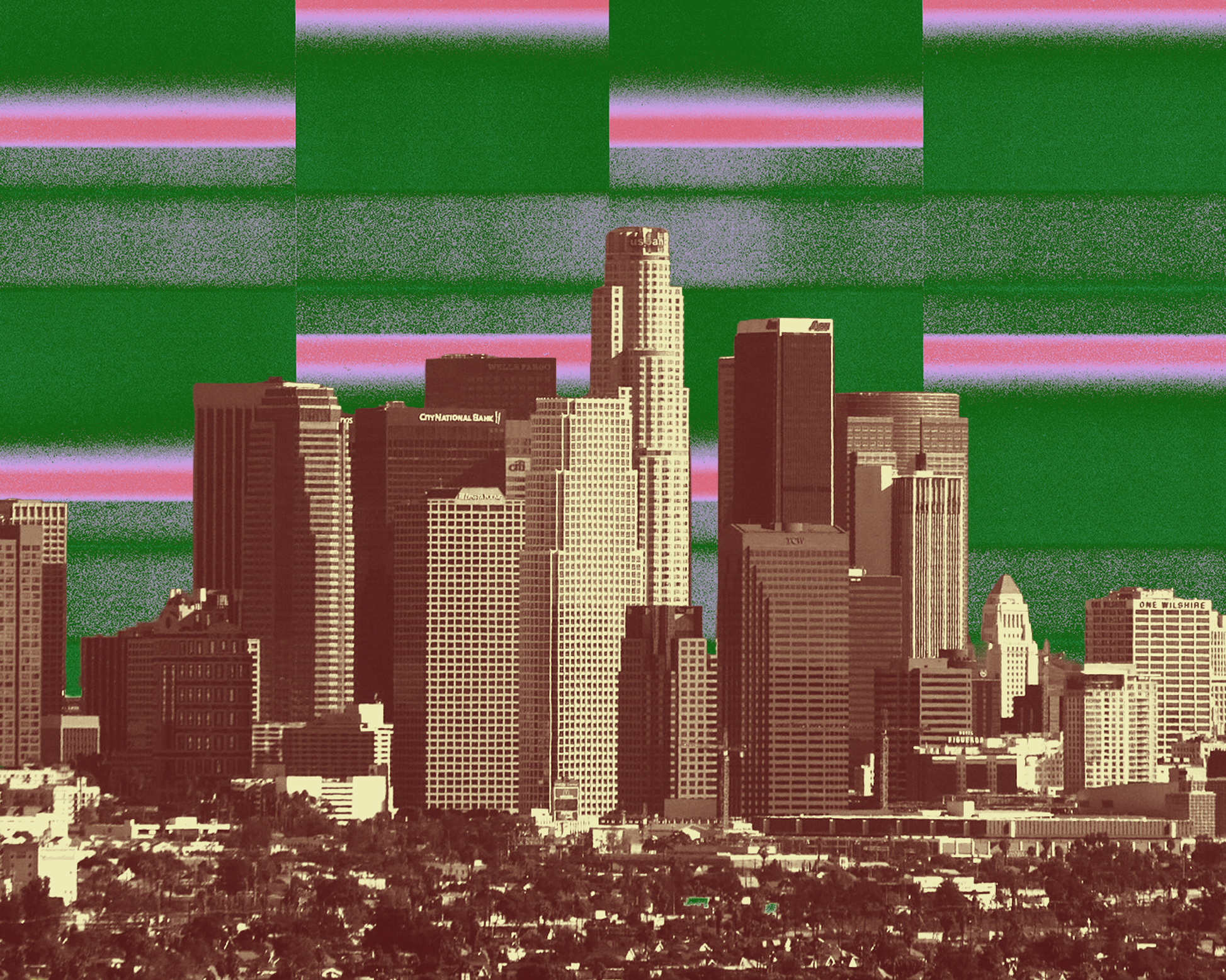
Illustration by Sophie Douala
“There is music even when we don’t recognize it as such.”
—Morgan Parker
“I had visions of you” cascades from megiapa’s lips on a recent evening at a diner in Inglewood. Sitting in a booth, hair starkly parted in the middle, she seamlessly moves through genre-bending landscapes, jumping from hip-hop to punk. She’s singing at Tal’s Cafe, where musician Micky Maestro hosts monthly shows. Unassuming in appearance, the door is clearly run by a community member who has their “shift” tonight. They kindly ask for $10 while joking that they can fight; they’re sweet enough for me to potentially believe them. The diner is lined in dark wood, with blinds open and fluorescent lights toward the entrance. Awkward seating makes things more intimate and requires us to sit almost on top of each other, to share a table and a meal with potential strangers or kin. “If you smokin’ in here, share—show some decorum,” Mickey says over the microphone. “That tip jar ain’t full enough!” We order breakfast for dinner, and the house speakers play music between sets as conversation erupts between guests. I’m not from this scene, admittedly new to this, but still, I feel welcome. I clumsily ask a man at the diner if he was still reading his menu, and he graciously hands it over. Little do I know it’s one of the fuckin’ performers. I have silly decorum in spaces like this, where I don’t know the difference between listeners or musicians. All lines keep blending into one.
My father, on the other hand, crossed a wall to get here, reaching for Led Zeppelin, Donna Summer, and Chocolate City. Had white american dreams that he would be a movie star. Escaped East Germany transcribing radio waves and clicks over monitors to find a new name and a new voice, all leading to him running into my mother walking down the street in Mid City. Said, “Howdy neighbor,” in a cowboy cosplay. My mother, in a tweed Chanel suit like a Black Barbie, giggled, thinkin’ he was gay. She, like a dream, was a sound he been chasing without knowin’. Bonding over live music and Killer Shrimp down by the Marina, my parents fell in love one summer in 1992. At the midpoint of disaster, a Black woman and an Eastern European man crossed racial lines and got married. They raised me in a bubble outside of Pan-African and Soviet culture, their love a Resolve to sever themselves from their cultures of origin. I have been raised painfully american. And I mean american in a particular way…like… My parents valued consistent exposure to european classical music and Radio Disney. We went to museums consistently but saw almost entirely white artists. I grew up well-rounded in a culture that they were trying to claim for themselves.
Their live music escapades came to an end when I was born. While I was raised far away from a traditional “music scene,” I was also brought up close to places where spirit convened: the church.
White Women, a four-part jazz ensemble made up of no white women, take to the mini stage at Tal’s Cafe. Percussive drumsticks clap between the walls; the guitar and keys form padding around it; the singer vocalizes hauntingly, as if she were an instrument herself. At one point it sounds like she’s saying, “Send it on.” I feel a pull in my chest that makes me feel compelled to crane my neck, my ears, to reach toward where the music is coming from. Every time there is a pocket to get comfortable in, White Women don’t stay there too long, immediately dodging to the next rhythm they can find, that they can catch. Throwing each other off intentionally just to reassemble again. I feel compelled to tap my fingers against the table, somethin’ wants to flow through me. I see the people around me, eyes glued to the musicians, heads boppin’ to the beat, the room filled to the ceiling with hazy smoke. My friends and I exchange nods of excitement. We never know where we are goin’ when we are at a jazz show. You gotta hold onto whatever it gives you and let go of convention. Welcome the idea of improvisation, which is nothing all that distant when you think about it.
When I was 21 years old, I got kicked out of my childhood home. Couch surfing throughout Los Angeles, I found myself sleeping through mornings and living outside at night. I needed to be surrounded by people to remember I wasn’t completely alone or abandoned. Often that meant being at concerts, ranging from large venues to backyards. The years 2015 and 2016 were times to be alive in LA. Rising acts like MUNA were performing at the Pink House at USC and Dckwrth’s career was on the rise as he entered the live performance circuit. At the same time, I was a member of a local open mic’s slam poetry team, competing at nationals, and performing in group pieces throughout California. Away from home, belonging became a prevailing preoccupation for me. I lived off the intimacy of a small venue, cobalt blue lighting with purple and pink fringes, shoulders touching, and stomping our feet like on Sundays. Same way I’d feel watching Amiri Baraka on YouTube and being exposed to a different kind of music, a different kind of beat, where I feel so close to the performance that I can live inside the grief momentarily. It is here where I have felt as close to God as a child. I believe I survived houselessness because I was guided by feeling, what places felt like a holy house, for those are spaces where I could cross the line of fear and transform it into promise. Years later, Tal’s Cafe had that feelin’ brewing in the air that night.
After the coronavirus lockdown, my first time back outside and socializing in four years was at a backyard show presented by Minaret Records in 2024. Attempting to keep up with conversations and social cues, I found myself stumbling stealthily through interactions with strangers. My socializing skills hadn’t been sharpened in those years, due to both the lockdown and a stem cell transplant. Feeling similar to the instruments onstage, I needed to be steered toward rhythm and a break. At every point of the evening, whether outside in smoke circles drinking beer or inside the house quietly looking on in a cramped living room, I related to the music. It was the perfect sonic backdrop to an evening where I was hiccuping and grooving alongside curveballs. At the end of the night, I sat in a shed and jammed with Minaret Records founder Yousef Hilmy and other musicians, improvising on guitar, tambourine, and keys. Hilmy has been throwing underground jazz shows throughout Los Angeles for the past half-decade. Over the last two years, I’ve watched Minaret shows everywhere from the backyards of people's homes, with fairy lights and beer, to random lofts in Downtown Los Angeles with moody lighting and exposed ceilings, to venues like Lodge Room. Every Minaret Records show has been where I have had to work through being hesitant about crossing into unfamiliar territory: Am I invasive or welcome if I am new to jazz?
A friend recently asked me what I mean when I say “new to jazz,” and I had to laugh at myself, because it’s like saying I’m new to living. But there is something to be said about the genre itself, making you aware of the disruption of the mundane through gathering. The gathering of notes, the gathering of people, the gathering of communities, having disregard for previous conventions, and choosing to draw new lines. Jazz is in places where we convene. My parents thought they could keep me isolated in the wild. As if life works that way, as if music, as if jazz, doesn’t live in everything. I remember my mother rapping, “Who the fuck you think I am? I’m the fuckin’ boss,” by Rick Ross, or singing songs by the Roots and Tupac, and I know there were glimpses of jazz in that. In the funk she’d have us clean the house to on the weekend, too.
Jazz itself was often regarded in my home as a thing to exterminate, as if it were an invasive virus. But it still found its way through, it still peeked in, because my mother is my mother, after all, and the eldest daughter never forgets her nation of origin. Sometimes my mom would cross the very lines she drew for me, into what she deemed “savage,” by rambling over a beat and making up beats for herself while sitting through traffic on the 10 freeway. She’d use innovation to break time and bend it to her will. Tapping her fingers across the steering wheel in intricate drum patterns, my mom was making magic out of the everyday, and therein lies her innovation. You can’t separate us from the need to create, and to be born again. Even if this sound, even if this way of being, is shielded from me, it has found ways to enter in and out; it’s taken decades to find me, at times, but I hear it clearly now. The sound of everyday life. The threadings between genres, between mediums, where jazz is everything in conversation with each other, followed by asking a question pointed toward the future.
Chuck Strangers stands in a navy blue shirt, black cap, and oversized aviator glasses, rapping, “To know god is to know joy, to live life is to know pain.” An audience member shouts, “One day at a time nigga.” Everyone has finished eating, and they are clamoring over each other to see Strangers up close. He chases the beat and dodges it at the same time, reminding me of the Alchemist and Armand Hammer. My friend and I weave our arms around each other and syncopate our rhythms to each other and to Strangers. It’s been a dreadful year, but moments like this make me think about feeling at home temporarily. Where the church morphs over the years. But that recognition of belonging never leaves. “It was me and my dawgs, they seen me through it all,” Strangers spits into the microphone. I’m reminded of how my father practiced something like echolocation to find something like a pod, and made a world with my mother. I imagine that I, too, have been clicking and radio signaling for decades, waiting for the resonance to strike back. Where I can be lost in a moment alongside people who are also artists who are also musicians who are also tired who are also working who are also just trying to find moments of threaded magic. Moments to cross the line beyond a borderland, where we are curious to find ourselves on a ride home, without a map, just carrying something like faith to guide us to each other. Erecting a church in the wild. Bouncing psalms and songs all around us.
RELATED ARTICLES