
November 9, 2026
The Cosmogram of John Coltrane
Every composition, every improvisation, every restless search for new sonic language reflected Trane's pursuit of something larger than artistic mastery.

Sophie Douala
“For the next hour Coltrane would let us hear what he felt, thought, saw, was seeing, like the skyvision of the Revelator on Patmos. Soon, live, there was only one piece per set. Without Miles to tell him he was playing ‘too long.’ But if you run into any of us who were then thus showered with high meaning, we would say, ‘he could still be playing, if it was up to we.’”
— Amiri Baraka, “Later Trane”
To write about John Coltrane in the past tense feels insufficient, almost inaccurate. Coltrane resisted the language of absence. More than 50 years after his passing, his presence continues to shape the emotional, spiritual, and sonic vocabulary of modern music. His music does not sit quietly frozen in archives or even in the finest vinyl collections. It breathes, expands, and calls listeners into deeper ways of hearing. The question invited by the centennial of his autumn equinox birth, on September 23, 1926, is not simply how we remember Coltrane, but how we continue to animate his presence in improvisation, in ritual, in scholarship, and in the enduring search for transcendence that his music still demands.
Yet to write about Trane as merely a musician is to miss the rhythm and movements of his life. Every composition, every improvisation, every restless search for new sonic language reflected a man pursuing something larger than artistic mastery. His music carried that conviction because his life did. To listen to Trane’s music without a similar conviction is to miss the way he attempted to “reconstruct the universe” through sound. To listen with conviction is to hear what Amiri Baraka called Trane's “Other,” that profound audaciousness pushing beyond technique, beyond convention, and beyond the accepted limits of musical expression. His improvisations became inquiry, devotion, confrontation, and supplication all at once. His music demanded transformation, a disregard—albeit not a discarding—of ways that did not move him forward. As Trane would say, “Damn the rules, it’s the feeling that counts. You play all twelve notes in your solo anyway.”
Listening to Trane reveals that his life and music moved through a cycle of transformation. Through the framework of the Bakongo of central Africa and their Dikenga dia Kongo, Trane’s artistic and spiritual journey can be understood not simply as the progression of a musician, but as passage through a cosmic cycle of birth (kala) and the subsequent rise to mastery and communal responsibility (tukula). Through apprenticeships and personal development to the transcendent offering of A Love Supreme and before and beyond — cuz past is always present and forever moving forward — Trane approached music as a practice that was rooted in constant evolution and improvisation. Speaking about her friend Nikki Giovanni, Barbara Crosby once wrote, “Maybe I was listening with the wrong part. Maybe she was communicating love to the Black soul and I was using Western-trained ears.” Perhaps we have been listening to Trane through the wrong set of ears.
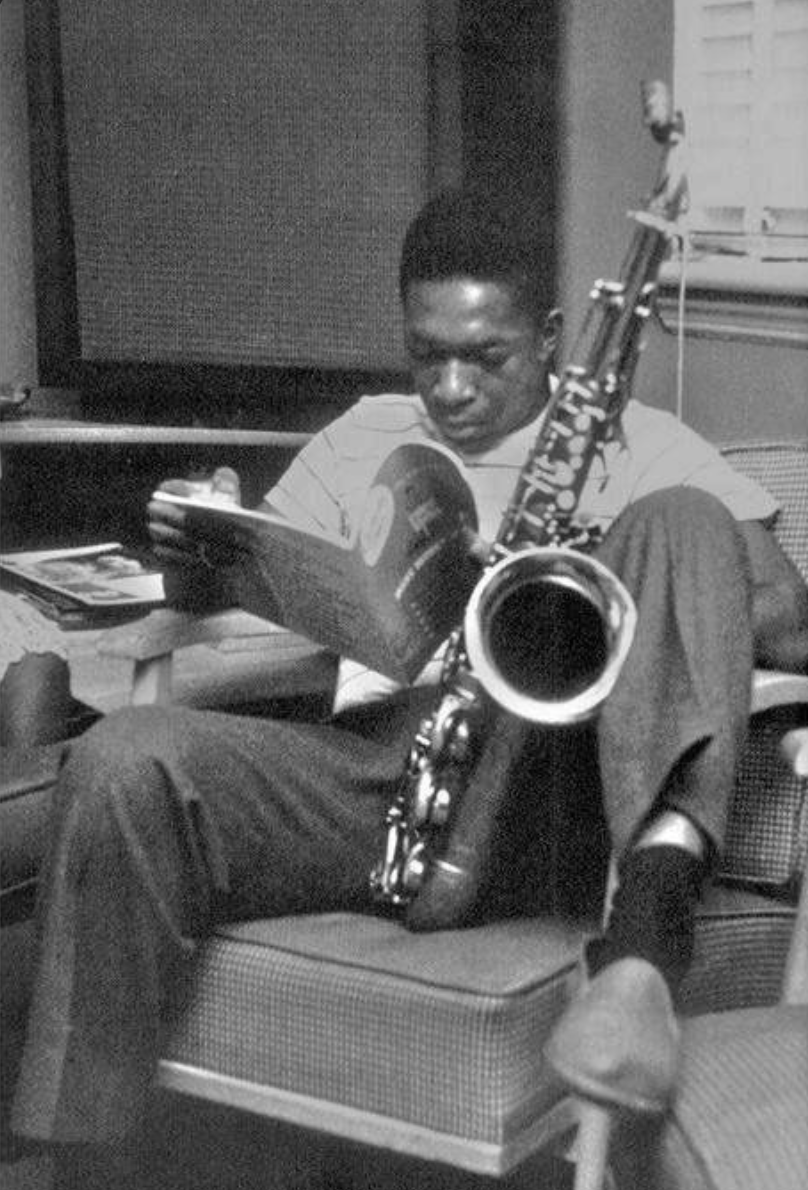
For decades, Trane's life has been interpreted through biography, music theory, Christian and Eastern theologies, and the familiar mythology of genius. These readings have deepened our appreciation of his work, but they often leave unexplored another archive of interpretation: African ways of knowing. To understand Trane more fully requires gathering evidence not only from recordings, interviews, and criticism but from the philosophical traditions that have long shaped African understandings of creativity, memory, and becoming.
More than a symbol, the Dikenga dia Kongo of the Bantu-Kongo people of Central Africa is a philosophy of existence. Two intersecting lines trace the relationship between the visible and invisible worlds, while the horizontal Kalunga marks the immense threshold separating the living from the ancestral realm. The Kalunga, K. Kia Bunseki Kimbwandende Fu-Kiau explains, is understood as both entrance and exit, source and origin, an immeasurable force of continual generation and change. It is the place where endings become beginnings and where every crossing gives birth to another possibility.”
Encircling the cosmogram are the movements of the sun. The Dikenga reminds us that life does not move in straight lines but in circles. Becoming is perpetual. John Coltrane's life unfolds with remarkable coherence against this timeless cosmological philosophy.
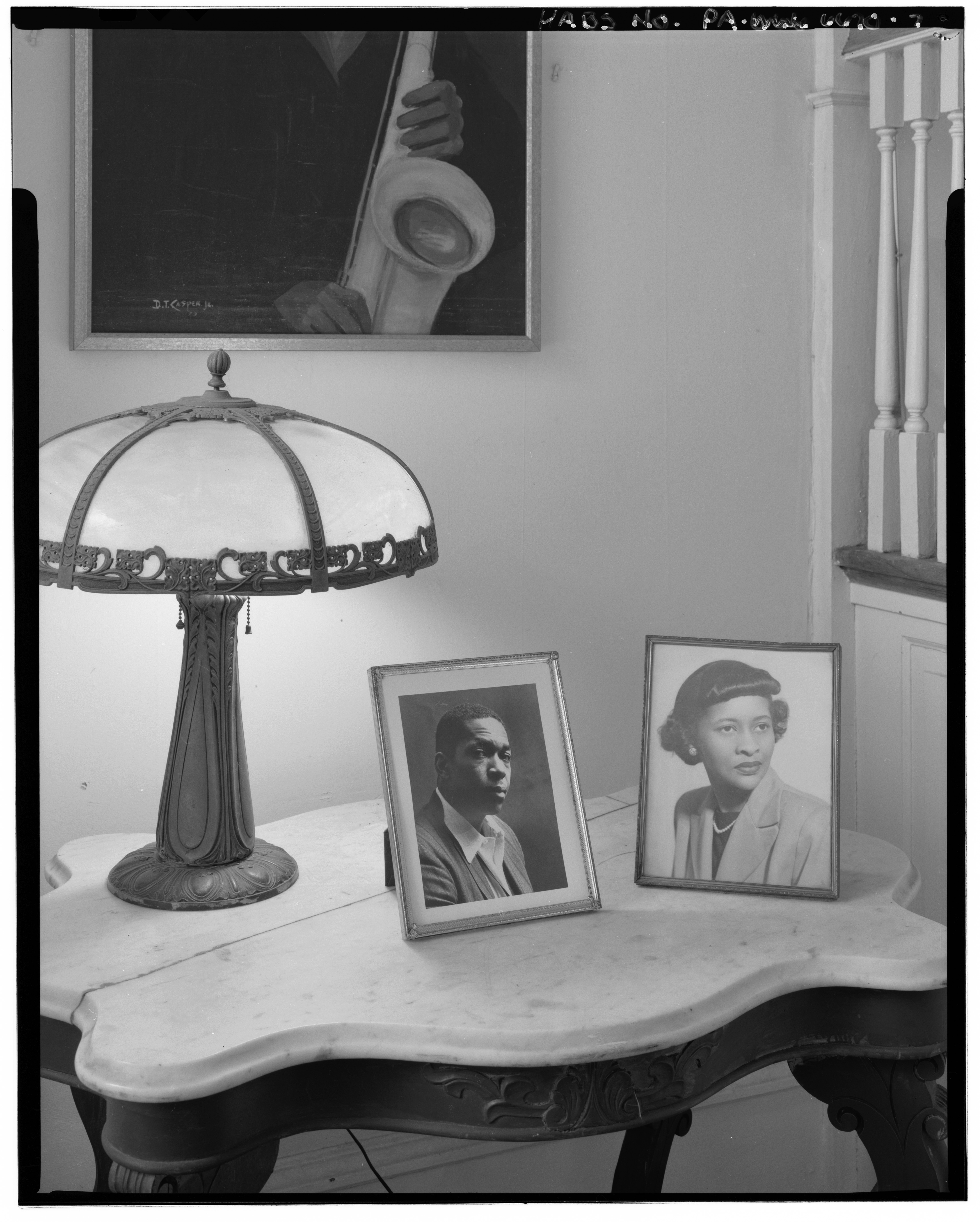
In June 1943, when a sixteen-year-old Trane boarded a train from High Point, North Carolina, to Philadelphia, he also carried with him profound loss. Between 1938 and 1943 he lost his grandparents and his father, ruptures that reshaped the emotional landscape of his young life. Philadelphia would become the beginning of his vaika—the stage in which ideas take root and identity begins to form.
The doorway into the physical world, the kala phase of the Dikenga, is the place where life rises into community. Here, concepts germinate and beliefs begin to acquire form. The future master must first become an apprentice.
The Dikenga insists that mastery begins with listening rather than originality. Jazz musicians have always understood this.
For Trane, apprenticeship was not simply musical training. It was a philosophy of living. The city surrounded him with new sounds. Johnny Hodges, Coleman Hawkins, Illinois Jacquet and above all Lester Young were constant companions through their records. “I chose the sax because Lester played it,” Trane later recalled. Although he first played alto saxophone, the instrument mattered less than did engaging the language itself.
The Dikenga insists that mastery begins with listening rather than originality. Jazz musicians have always understood this. Knowledge passes from elder to apprentice, from rehearsal to performance, from memory to improvisation. Trane absorbed this tradition completely. School teachers, neighborhood musicians, recordings, churches, and eventually mentors all became part of an apprenticeship stretching far beyond his own lifetime. Innovation, the cosmogram reminds us, is never created from nothing. It is inherited memory transformed.
If vaika is the doorway into becoming, then the Dikenga’s next movement is where becoming begins to take form. Kala opens the world of emergence, but it is not yet mastery. It is still an apprenticeship shaped by repetition, listening, and absorption. In Trane’s case, this stage stretches across years of relentless practice and disciplined submission to the language of jazz. But the cosmogram is not stagnant in this phase of emergence. It is fluid.
The next turn is vanga, the most crucial threshold in the Kongo understanding of human development. Derived from ghanga, which means “to do” or “to perform,” vanga is the stage where knowledge becomes action. Fu-Kiau describes it as the realm where creation is no longer preparation but realization. Where the Muntu becomes nganga, the healer, the specialist, the one who stands “vertically” in the world. It is here that mastery is not measured by age or accumulation alone but by the ability to transform inherited memory into living practice. In this stage, apprenticeship does not disappear; it deepens. Trane did not leave behind what he learned. He carried it forward.
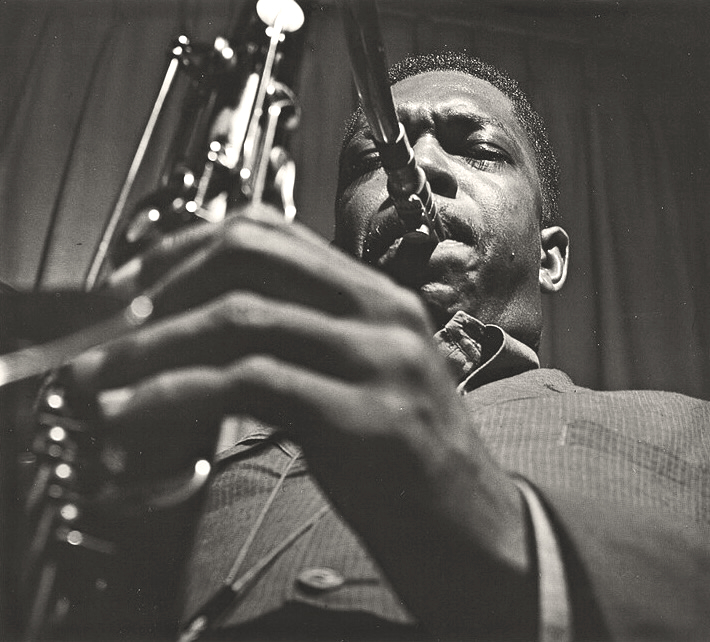
In his essay “You Have to Be Invited,” Leonard Brown describes jazz transmission as an “oral and aural practice, where knowledge is passed not through written instruction but through presence, repetition, and invitation.” Brown emphasizes that entry into the tradition is itself a form of recognition. Trane’s invitation came slowly, through recognition not only of skill but of seriousness. A seriousness that would eventually define his entire artistic life. Trane’s entry into this phase cannot be marked by a single recording or performance. It emerges gradually, through years of disciplined labor in bands led by Joe Webb, featuring the vocalist Big Maybelle; Dizzy Gillespie; Earl Bostic; Thelonious Monk; and, in two separate stints, Miles Davis. It is in these environments that Trane’s sound begins to sharpen. Every practice and rehearsal becomes a negotiation between memory and invention. Every solo becomes an attempt to extend the vocabulary he had inherited.
Within the logic of the Dikenga, vanga is also the moment when craft becomes an ethical practice. It is not enough to play well. One must play responsibly. One must play in relation to the community from which one emerged. This is where Trane begins to separate from the conventional expectations of jazz performance. Technique alone is no longer sufficient. By the early 1960s, his playing becomes increasingly driven by questions rather than solutions, no longer simply demonstrating mastery but constituting a search for meaning beyond mastery itself. Having signed to the Impulse label, only two years after leaving his second stint with the Miles Davis Quintet, Trane began pushing his sound to be more free. Inspired by the concepts of Sun Ra’s saxophonist John Gilmore, Trane’s inclusion of a second bassist in live sets and studio recordings allowed for greater freedom in improvisation, culminating with the 1964 recording of A Love Supreme, which foreshadowed the directions that he was taking his sound and us.
Released in 1965, the four-part suite is more than simply a creative peak as Coltrane approaches the cosmological turning point of tukula—the highest arc of the sun in the Dikenga, the moment of full maturity, illumination, and responsibility. Fu-Kiau describes tukula as the stage where human beings produce their greatest works of art, invention, and insight. It is also at this stage where the individual is most accountable to the community. It is an offering. “Acknowledgement,” the opening movement of A Love Supreme, is a declaration of arrival into responsibility. It is the sound of an artist recognizing the weight of what he has become, the responsibility of the gift that he has been given from the Creator. The suite that follows gathers years of earnest discipline, devotion, and searching into a single extended act of sonic prayer. It is an ethical principle that anchors it. How does one thank God (mostly) without words? Here, Trane fully assumes the role of nganga, as community-centered practitioner. In the Kongo tradition, the nganga is healer, mediator, and maker. In Trane’s hands, the saxophone becomes a vessel through which grief, joy, struggle, and transcendence are translated into shared experience; he is no longer simply mastering an instrument, he is attempting to repair something in the world through sound. Trane would say, “When you begin to see the possibilities of music, you desire to do something really good for people, to help humanity free itself from its hang-ups.”
This is why the later, heavily improvisational recordings that were often dismissed at the time as excessive or inaccessible must also be heard through this lens. Works like Meditations, Ascension or Interstellar Space are not departures from earlier forms of mastery but continuations of the responsibilities enacted at the tukula stage. These recordings push sound to its limits, not for the sake of rupture, but because the cosmological obligation of the nganga is to keep moving knowledge forward, even when words begin to fail.
And yet, within the Dikenga, no stage is final. After tukula comes luvemba, the moment of crossing, the passage through kalunga into the spiritual world, where life continues in another form. In this sense, Trane’s death in July of 1967 is not an exit from the cosmogram but its continuation. What remains is circulation. His recordings continue to move through listeners, musicians, and traditions that were not yet fully formed during his lifetime. His sound enters the ancestral world—beneath the kalunga line—itself shaping generations who will never meet him but who will still learn from him. To listen to Trane today is to participate in that circulation.
Trane once said he wanted to be a force for real good. The force he generated did not stop. It continues to move, like the kalunga itself—immeasurable, generative, always crossing between worlds. This is why this moment of his centennial matters. To listen to Trane is to enter one hundred years of movement, of that crossing. And to enter that crossing is to understand that the universe he tried to reconstruct through sound is still being built, century by century, note by note, listener by listener.
RELATED ARTICLES