November 9, 2026
Abdullah Ibrahim's Tradition
For Abdullah Ibrahim, who died this year at 91, the sounds of Cape Town – shaped by slavery, migration, and exchange across the African diaspora – represented the ultimate measure of musical greatness.
By Sean Jacobs
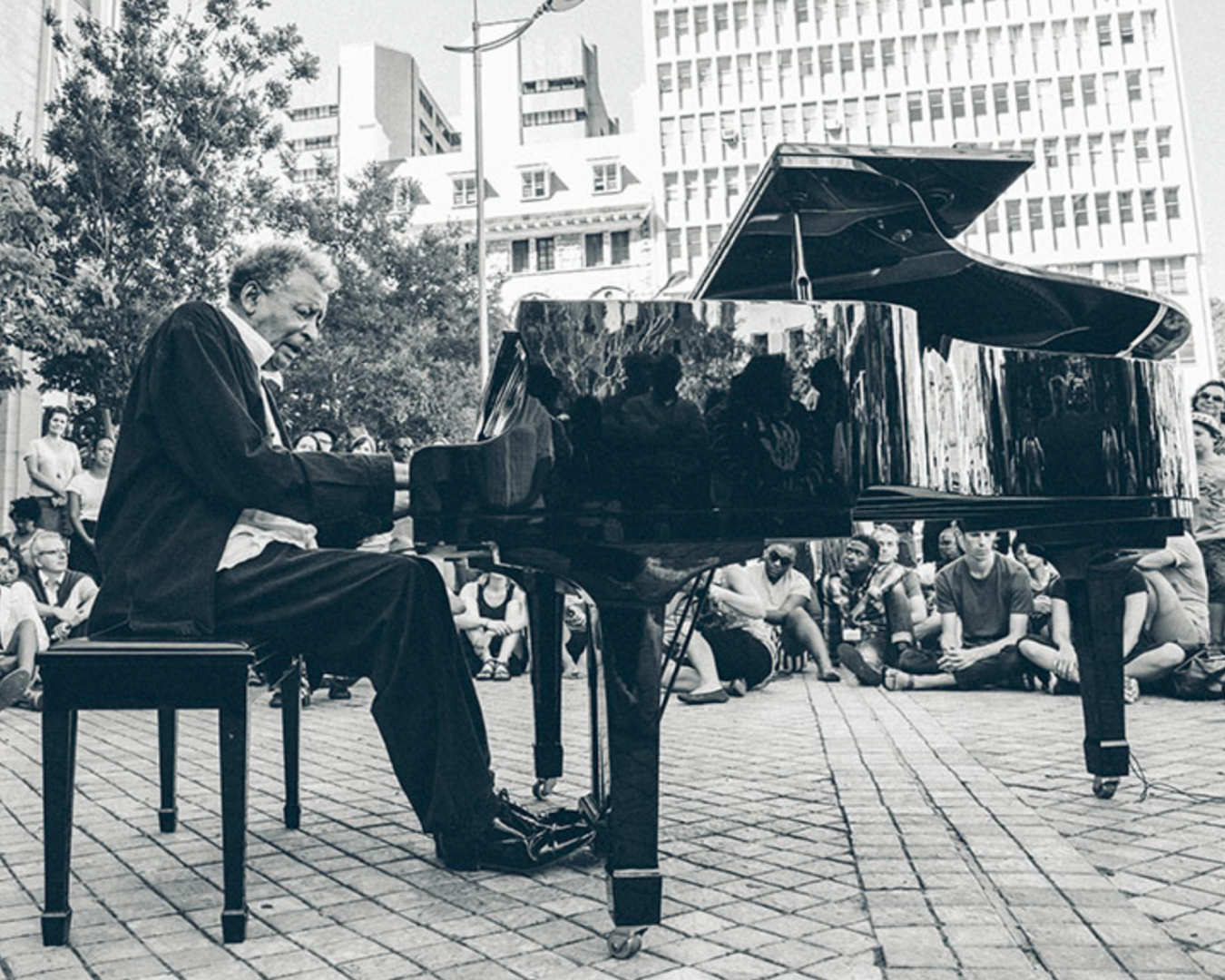
There is a video online, posted by the Swiss public broadcaster RTS, of a performance by Abdullah Ibrahim and Max Roach in front of a studio audience in June 1999. Ibrahim sits at an upright piano while Roach has only a hi-hat; the rest of his drum kit sits unused behind him. The performance, barely four minutes long, begins with the opening lines of “Nkosi Sikelel’ iAfrika,” the South African anthem associated with the freedom struggle against apartheid. About halfway through, after a few brief accents, Ibrahim shifts into “Blues for a Hip King,” his tribute to King Sobhuza II of Swaziland, written during the early 1970s, when Ibrahim lived there with his then-wife, the singer Sathima Benjamin, and young son, Tsakwe, among a community of South African exiles, artists, and political activists.
Roach, born in Brooklyn, never visited South Africa but had spent years in close orbit with Ibrahim. And somehow, what emerges in the performance is something older and deeper than their shared jazz lineage: Roach is playing a drum pattern that resembles the goema – the rhythm associated with the music of enslaved people from Asia and Southeast Africa, kidnapped and brought to the Dutch-ruled Cape Colony beginning in the seventeenth century. In that moment, you hear not simply another jazz master accompanying Ibrahim, but Ibrahim showing Max Roach how to play his music.
This, then, was one of Ibrahim's singular achievements: whether playing solo piano or leading groups (for much of his career, made up of American musicians), he drew both performers and listeners toward a sound richly grounded in South African history and sensibility. Perhaps Roach recognized something familiar in that exchange as well. Maybe he was intuiting a blues-inflected groove, making the connection across the Black Atlantic feel natural and inevitable.
In a 1986 interview, Ibrahim insisted that South Africa’s musical traditions were not merely influences but the foundation of his artistic vision. Reflecting on years spent abroad listening to internationally acclaimed musicians, Ibrahim argued that genuine artistic understanding begins with an honest engagement with one’s own cultural inheritance. What moved him most deeply was not music celebrated by global consensus, but the sound of Cape Town’s carnival bands: the tambourines, banjos, bass lines, and rhythms that brought him close to tears. “How am I going to deride this?” Ibrahim asked. “Because there is no music that does this to me. Except that. That for me is the yardstick. I don’t care how intellectual it has been considered.”
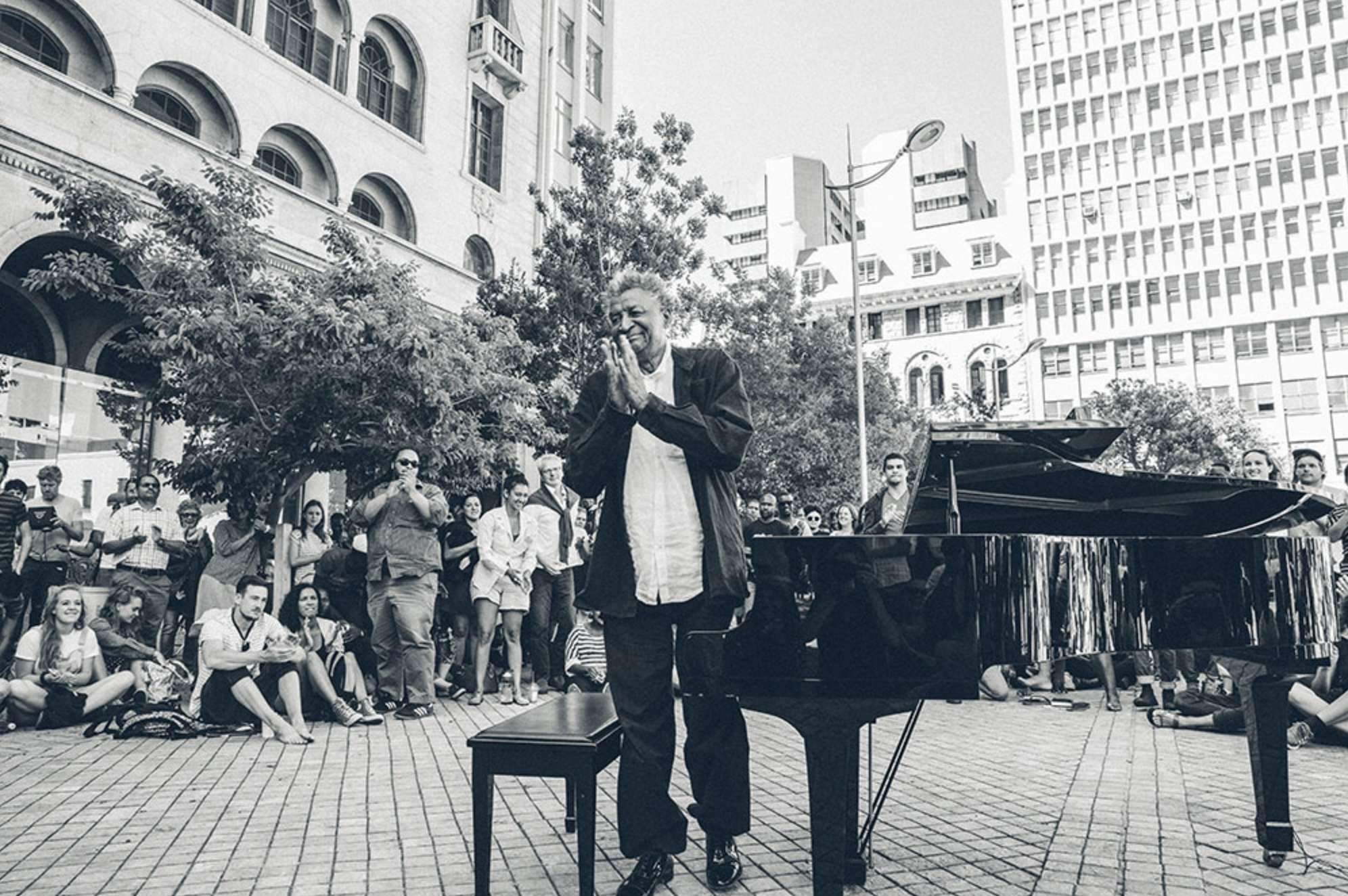
Ibrahim cared little about prizes and decorations, but his distinctive and wholly original synthesis of the idioms of his hometown and the vibes and sounds of the Black townships into a global musical language led Nelson Mandela to call him “our Mozart” and earned him recognition as a National Endowment for the Arts Jazz Master from his peers in the United States. Ibrahim, who died on June 15 at 91, began developing this style in the 1950s. For him, this music – shaped by slavery, migration, and exchange across the African diaspora – was the ultimate measure of musical greatness. He called it “the tradition.”
--
Listening to Ibrahim lends itself to a parlor game: How many familiar melodies or fragments can you recognize as they drift through the music? If you’re a Capetonian or from almost anywhere in South Africa, it’s hard not to play. Cape Town folk songs surface in his compositions, woven into improvisations that blur the line between memory, culture, and jazz’s inventiveness.
One of the clearest examples of this is Ibrahim’s composition “The Moon,” which he first recorded on the 1969 album African Piano (Live at Jazzhus Montmartre, Copenhagen). The song is essentially a reworking of an Afrikaans folk song, familiar to me from childhood, “Die Maan Skyn So Helder Vanaand” – the moon shines so bright tonight.
The song’s precise origins are unknown, but among Capetonians it instantly invokes nights among the coloured working class and the cultural traditions of rural farm communities. At a faster tempo, it also appears in the repertoire of Cape Town’s Klopse or carnival troupes, who take part in the annual New Year’s festivities that emerged from celebrations marking the end of slavery in the Cape. Ibrahim transforms this folk melody into a solo piano work, propelled by a driving pulse and a piano sound that evokes a harpsichord.
The contemporary Cape Town pianist Kyle Shepherd later picked up this thread. Shepherd has been performing his interpretation of “Die Maan Skyn so Helder Vanaand since at least 2009. He recorded it on his album Fine Art (2011) and again with the Cape Jazz Band on the album Musical Democracy (2013). Whereas Ibrahim’s version is driven and percussive, Shepherd’s is slower, more improvisational, and ballad-like. He sings the lyrics, which warn of a jackal threatening livestock. Yet Ibrahim’s influence remains unmistakable, especially in the refrain.
The connection between Ibrahim and Shepherd is both musical and personal. Shepherd’s mother, Michelle, played violin in Ibrahim’s touring orchestra in the late 1990s. As a child, Shepherd spent time at Ibrahim’s M7 music school in Cape Town, where his mother taught and handled administrative duties. Now best known for film scores and collaborations with artist William Kentridge, as well as his bandleader work, Shepherd has frequently acknowledged Ibrahim’s influence, saying that Ibrahim’s solo performances “affected me profoundly” and helped convince him that a life in music was possible.
If Ibrahim’s version of “The Moon” demonstrated how a Cape folk song could be transformed into jazz, Shepherd’s return to “Die Maan Skyn so Helder Vanaand” decades later illustrates something equally important: the extent to which Ibrahim indeed transmitted his “tradition” to those who have come after. He gave younger musicians permission to hear the sounds of the Cape – not as raw material to be chewed up and abandoned in pursuit of international jazz, but as a foundation from which new jazz could continually be made.
[[ PQ: Ibrahim’s compositions “have a feeling that they’re the same type of songs they built the pyramids with,” Don Cherry once said. “He can make you really aware of this timelessness.” ]]
--
By 1968, following his conversion to Sunni Islam, Ibrahim had shed his birth name, Adolph Brand, and his nickname, Dollar, which he claimed U.S. Navy soldiers had given him as a child, when he was always asking to buy their jazz albums off them. In these years, he sometimes alternated between his new name and the Khoi name Xahuri, reflecting a growing engagement with indigenous cultural traditions. Ibrahim’s compositions “have a feeling that they’re the same type of songs they built the pyramids with,” Don Cherry once said. “He can make you really aware of this timelessness.”
Another early composition illustrating Ibrahim’s deep engagement with the Cape tradition is “Ancient Africa,” which opens the 1973 album of the same name. During this period, Ibrahim had temporarily returned to South Africa to reconnect with his roots and perform with local musicians.
On this recording, Ibrahim performs alone, occasionally setting aside the piano to play flute. Ibrahim faintly chants, in Arabic, “In the name of God, the most merciful, the most gracious,” in a nod to his own conversion and the Cape’s Islamic heritage, rooted in the Dutch slave era and the long struggle against white supremacy.
“Even when the surface language touched bebop or American jazz,” said the drummer Kesivan Naidoo, who performed in an ensemble led by Ibrahim in the early 1990s, “the deeper phrasing, the dance pulse, the hymn-like quality, and the Cape melodic sensibility were already part of him. He wasn’t simply imitating American jazz and then returning home; he was already carrying home inside the music.”
Throughout much of the live recording of “Ancient Africa,” Ibrahim hums, groans, and sings along with his playing, as though physically wrestling melodies out of an older, collective archive. Thinking about that record, Naidoo told me, “It has that circular, walking, dance-like quality that is so central to Abdullah’s language.”
The bassist Benjamin Jeptha hears those traditions immediately, too. Born in Cape Town in 1992, two years after Nelson Mandela’s release from prison, Jeptha grew up in Mitchell’s Plain, the second largest township in the city, and, like Ibrahim earlier, received his first musical education in church. When I asked Jeptha whether he could formally identify the specific melodies Ibrahim was playing on “Ancient Africa,” he said he could not.
“A lot of these melodies don’t even have formal names,” he explained.
Yet the music of “Ancient Africa” was instantly familiar to him when he first heard it. “The entire piece is incredibly reminiscent of the music I, we, grew up hearing played in church or on the streets during Tweede Nuwe Jaar,” the day Cape Town’s carnival troupes traditionally march through the city center, reclaiming streets from which Black and coloured people were removed during apartheid. Dating back to the end of slavery, the carnival has long carried a transgressive significance in Cape Town, a city that remains deeply unwelcoming to much of its Black majority.
Jeptha also notices the imprint of Christian missionary traditions on the piece. “This style sounds very similar to old Apostolic Christmas band music,” he said. He recalled that when he played bass in a trio with Shepherd and fellow Capetonian drummer Claude Cozens, the group would often drift into free improvisation, with Ibrahim-associated melodies surfacing naturally. “It felt very familiar and almost inevitable,” he said. “Even without knowing the specific tune, I knew the chord progression and direction of the melody as if I had played that song a thousand times before.”
Of course, just as jazz has deep African roots, the folk and religious musical traditions of Ibrahim’s Cape Town have an American heritage too. Ibrahim grew up in the African Methodist Episcopal (AME) Church, a denomination founded in the late eighteenth century in the United States by free Black people, who then sent missionaries to South Africa. As Oliver Layman, a cultural theorist of the Black Atlantic who is also from Cape Town, reminded me, this is perhaps another connection that helped Ibrahim to slot in comfortably with African-American musicians who came from a tradition rooted in the Black church.
Jeptha observed that Ibrahim’s contribution to the canon “wasn’t just about imitating a style, but rather channeling a collective memory that belongs to the streets and churches of Cape Town.” To that, I would add the American South and European traditions.
--
Ibrahim died after a brief illness in Aschau im Chiemgau, a village in Bavaria, Germany, where he lived.
Those present at his funeral, held a week later, reported that Ibrahim’s coffin, draped in a traditional green cloth bearing verses from the Koran, was placed at the foot of an altar decorated with Christian iconography, including a wooden sculpture of the crucifixion. Those in attendance sang AME hymns Ibrahim’s grandmother had taught him (the pages were copied from an old hymnal that rested on the piano at his house). Then an imam recited the funeral prayer, or Salat al Janazah.
It was a fittingly syncretic final scene for an artist who, though he spent much of his life away from South Africa, was ultimately of Cape Town, a city where such cultural cross-fertilization was a matter of fact. All these influences ultimately found harmony in his music.
RELATED ARTICLES