November 9, 2026
The Children in the Frame: How Alice Coltrane Became the Mother of Home Recording
A feature on independent distribution models in the streaming era.

Dek?
DISCUSSED:
A Monastic Trio (1968), Huntington Ashram Monastery (1969), Ptah, the El Daoud (1970), Journey in Satchidananda (1971), and Universal Consciousness (1971), The Carnegie Hall Concert (2024)
In 1970, Newsday published a photograph of Alice Coltrane in her home studio, her children gathered around her as she worked the control board. Even if they were aware of the camera, there is something unforced about their attention. No one seems posed. A portrait of her late husband, John, perches on a nearby ledge.
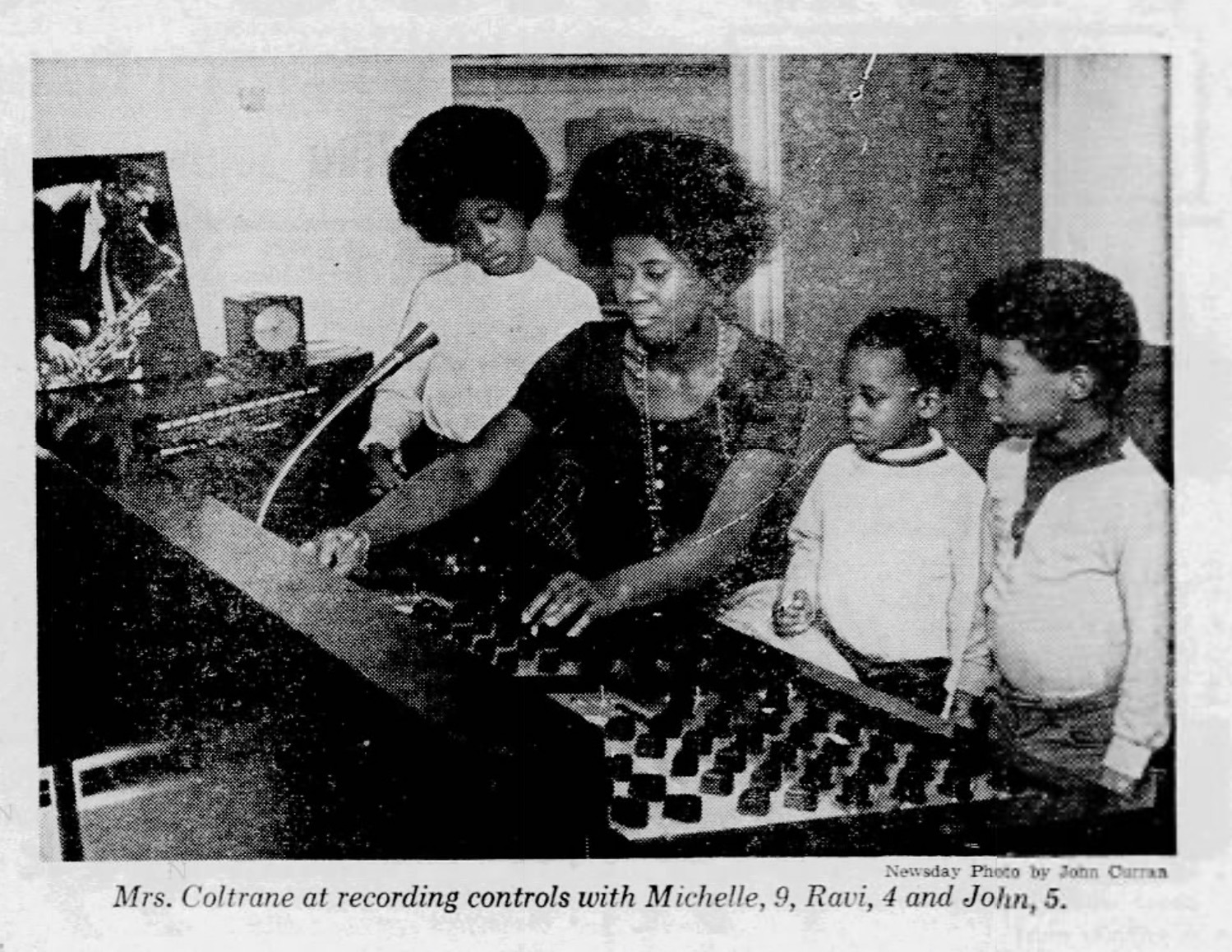
Fig. 1. Newsday, 1970. Alice Coltrane in the studio with three of her children, Dix Hills, New York.
I encountered this photograph a few years ago while I was writing liner notes for Alice’s The Carnegie Hall Concert (2024). I was pregnant at the time, and the photograph seemed to answer a question my body and mind were tensely negotiating: could motherhood and a creative career exist in the same frame?
I knew that it was extremely rare for a musician to have a home studio back then. The best-known home setup of Alice’s milieu belonged to Rudy Van Gelder, whose family’s Hackensack living room hosted John’s first sessions as a leader in the late 1950s. But Van Gelder was a recording engineer, and Alice was a musician.
“The four huge speakers, one for each track of the four-track recording deck, reacted immediately as she removed echoes from the tape and tuned to the proper pitch so that each instrument could be heard alone first and then together with the other five pieces in the sextet,” reported Newsday.
Alice’s home studio, located in the basement of her home in Dix Hills, Long Island, was up and running by 1966, before Brian Wilson’s, Sly Stone’s, or Paul McCartney’s. Yet her name is rarely mentioned among the pioneers of home recording.
Instead, the Alice we remember is a spiritual figure. And rightly so. But what’s less understood is that she was enterprising and pragmatic, someone who knew how to use money and property to shape her circumstances and the lives of those around her. One expression of that pragmatism was architectural: fashioning the Dix Hills house to accommodate the life she wanted, including constructing a studio that would allow her to maintain full creative control and to continue furthering her musical work while raising four young children as a single mom.
To build it, Alice called the Audio Recording and Manufacturing Company, a studio near Hempstead, about a thirty-minute drive from Dix Hills. Roy Musgnug, then in his early twenties and working at the company, fielded the call. When he described the studio and the location work the company did for schools and colleges over the phone, Alice replied: “Oh, you don’t do construction work?” She “didn’t know exactly what we offered,” Musgnug remembered in an interview with Ashley Kahn. Then she told him what she actually wanted. “I want to build a studio in the lower level of my house,” she said. John’s name did not come up, and Musgnug recognized her only in the course of the call.
Musgnug had never built a studio, so he recruited a colleague twenty years his senior, Walter Bonek, chief audio and production manager for Decca/MCA in Manhattan. The two men drove out together to quote the job. Once the terms were agreed to, Musgnug and Bonek worked afternoons into the night, often until eleven, for roughly two and a half to three weeks. Musgnug never met John, who was, he remembered, “either in the hospital or upstairs with a caretaker” while the work was going on downstairs.
When they were finished, the room was outfitted with a full mixing board, echo units, Telefunken microphones, and three Ampex tape machines: a two-track, a four-track, and an eight-track. Archival photographs show the layout from a few angles. On one side: the control room and its wall of tape machines. On the other is a live room, modest in size but large enough to hold a working ensemble along with her piano and harp.
Ed Michel, Alice’s A&R at Impulse!, remembered an isolated control room with talkback to the live room, two Ampex ½-inch 4-track machines and an Ampex 2-track, and a nice selection of professional microphones.
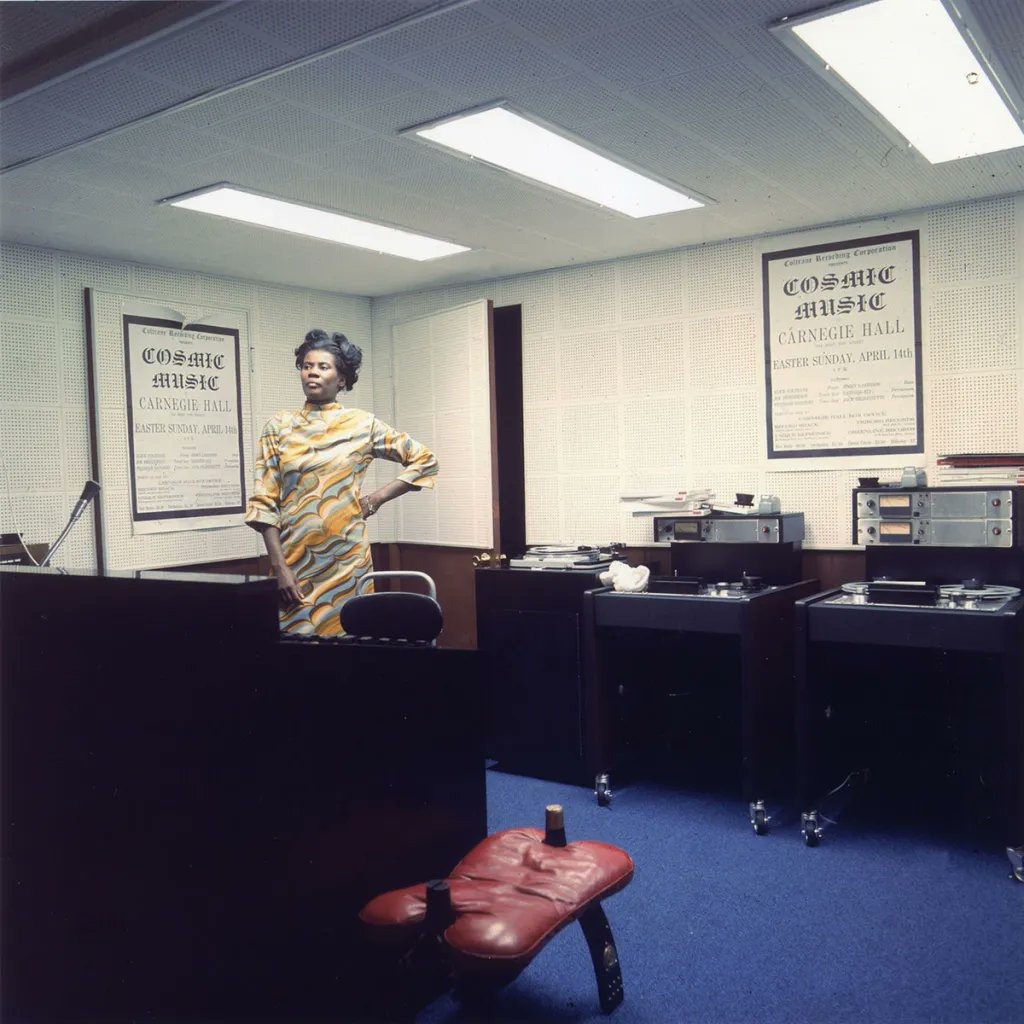
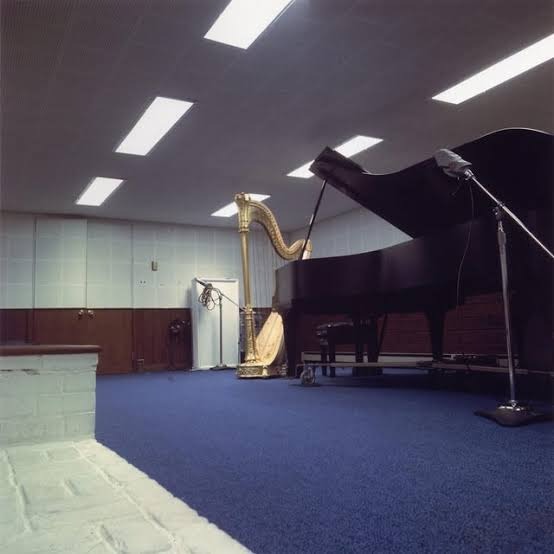
Chuck Stewart photos
Depending on who you asked, the studio was either advanced or limited. There is a way of thinking about recording studios that assesses a room by what it has: the technology of the board, the wall treatments, the arsenal of microphones. By that measure, the basement at Dix Hills was modest. Michel later described the Dix Hills studio to me as "a very advanced garage studio" — good, he wrote, but without the more sophisticated wall and ceiling treatments, the acoustically tuned control room, or the microphones and dynamics processing that a professional facility would have offered. "[She] made good use of it for small-scale projects," Michel wrote, "but it was inappropriate for the larger ensemble pieces we worked on later." Yet in Musgnug’s estimation, at a time when many professional rooms in New York were still running on four-track, it was a serious facility.
Alice invited Musgnug back to engineer her sessions in the room he had helped wire. He proposed the terms: “No travel time. Studio work and editing work, I’ll make it all at one price. $50 per hour.”
He came at least twice a week, often after his day job teaching elementary school thirty minutes away in New Hyde Park, frequently on Saturdays and Sundays, passing through an electronic gate at the foot of the driveway to make it to the studio after the children were asleep. Sessions ran late (ending at one or two in the morning was typical) and he was back in the classroom by 6:30. Musgnug eventually cut his hours working for the audio company to be more available to Alice. Because Musgnug stayed more or less on call for her on Long Island, she did not have to book commercial studios in advance. The basement was always available to Alice, allowing her to create as the household went on around her. “The children get priority over the work,” she told Kent D. Smith of Newsday in 1970. “If they were a little older I would work more but now they are so small.”
In interviews, Alice credited John with the idea of the home studio. But from the very first phone call with Musgnug, she was the one doing the hiring, the booking, and the negotiating. By his account, Alice was a “pretty definite” director, running takes of eighteen or twenty minutes on ten-inch reels, spending four or five hours per piece, careful about bouncing four-track masters down to two-track. In his recollection, there was “never another engineer or another music person from any label” in the room.
“I learned to edit and work the control board by watching the engineers that recorded me,” Alice told Smith.
Alice worked out of her basement in Dix Hills for roughly five years, from 1967 until her move to California in 1972. Musgnug was there throughout that period. Within that span she released A Monastic Trio (1968), Huntington Ashram Monastery (1969), Ptah, the El Daoud (1970), Journey in Satchidananda (1971), and Universal Consciousness (1971), in addition to working on unfinished recordings that John left behind, including Cosmic Music (1968), a project that posthumously interwove their recordings. Having an engineer on call in a room she owned made the pace of those prolific years possible. That she made those albums at home while grieving and raising four young children is a separate astonishment.
For the children, nothing about having a studio in the basement seemed out of the ordinary, as they didn’t know anything apart from the reality they were witnessing. It was, as Michelle remembered, “just part of the home.” "She had the ability to keep doing her work on site,” Michelle told me, “and make some dinner.”
"I could hear it through the floor in my bedroom," she went on, "the music, and the tape spinning… you could hear the reverse sound of the tapes, and then the editing sound of trying to find that piece of silence to actually physically cut it with a razor."
"I never remember not being able to come in," Michelle continued. "I'd show up in my pajamas, because kids do, and my mom would keep playing, and my hands would be on her." The room in the house where her children truly could not go (“kind of off limits,” in her son Ravi’s phrase) was Alice’s bedroom, where she meditated. The instruments, however, were not roped off. "We were allowed to touch everything," she remembered. "We knew what the harp felt like. We could stroke it and stand on it, because we were so little. She had a tolerance to have a pile of kids around her feet laying under the piano."
Small interruptions Alice absorbed, gently shushing the children out and returning to the music. But her tolerance had limits. Ravi, Alice’s third child, told Ashley Kahn about a moment at the organ:
She was very deep in the music and I was — "Mom, Mom" — trying to get her attention. I reached up and hit the switch for the organ, turned it off while she was in mid-musical expression. She was not happy about that. I was immediately sent to my room and whatever it was that I was trying to get from her at that moment, I did not get. Ouch. Not a terrible ouch, but yeah, a memorable one.
The studio became an integral part of Alice’s self-presentation as an artist in the wake of John’s death. In April 1968, she takes Newsday reporter Bob Micklin down into the basement. “The lower level of the Coltrane home has been turned into a professionally equipped recording studio,” he writes, “with a bank of tape recorders, control booth, an extensive speaker system and a complex electronic control panel for monitoring, mixing and editing tapes.” She walks him into the control room and presses play. “Through the speakers came the plaintive, vibrant call of Coltrane’s saxophone” — a composition called “Rev. King,” which surfaced a few months later on Cosmic Music. “At night, after I put the kids to bed, I come down here to play and write,” she tells him.
The following year, in the liner notes to Huntington Ashram Monastery, Alice credits her influences (“Bud Powell and Thelonious Monk”), collaborators (“Ron Carter”) and instruments (her Lyon and Healy harp and Steinway). Among them, she includes the Ampex AG-440 tape machine. The four-track in the basement had become an essential ingredient in the recipe.
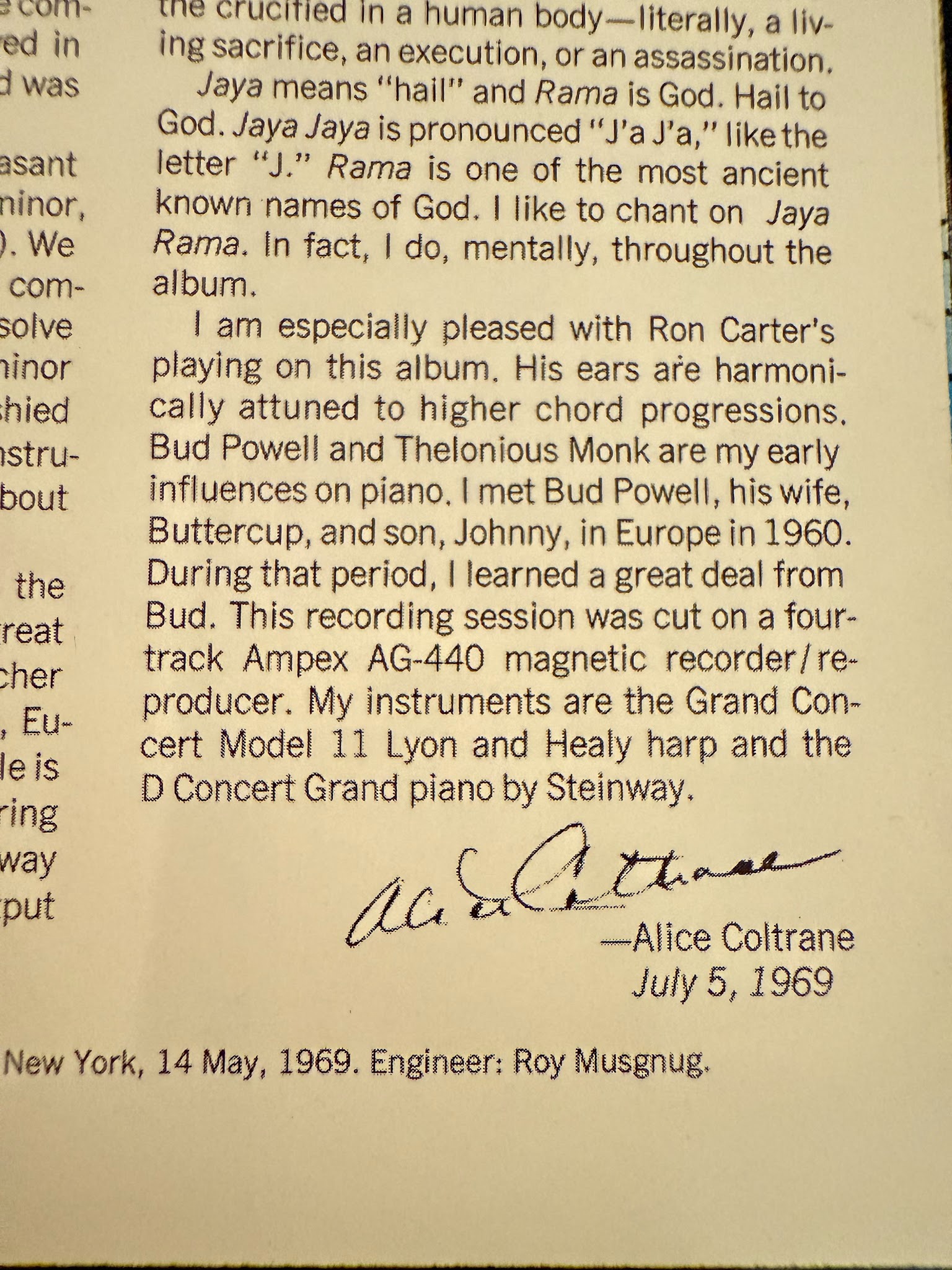
By early 1970, when Pharoah Sanders, Joe Henderson and Ron Carter drove out to Dix Hills in a rented station wagon for what would become the Ptah, the El Daoud session, Alice had learned to use the room's stereo field deliberately. Sanders is mixed to the right channel, playing what she calls, in the liner notes, "transcendental" lines. Henderson is on the left, playing the "intellectual" ones. Such placement was a compositional decision enabled by her skill at the controls.
Chuck Stewart photographed the session, and his contact sheets show the room in action: Carter, Henderson, and Sanders at work. Interspersed among the musicians are snapshots of her children. Michelle sits to the side in a fashionable dress, surveying the scene. John Jr., in a button-up and trousers, looks queryingly at Carter and his bass.
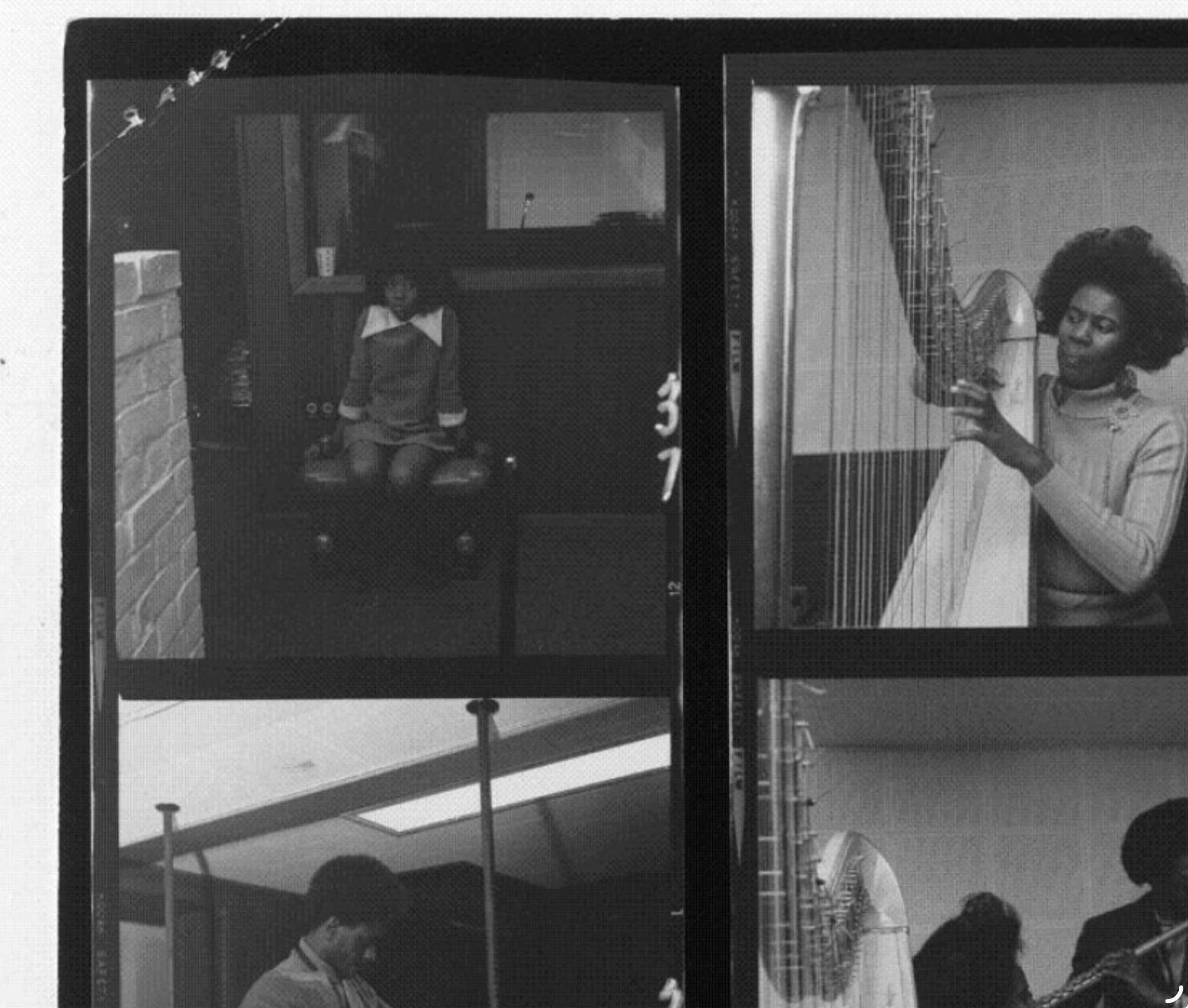
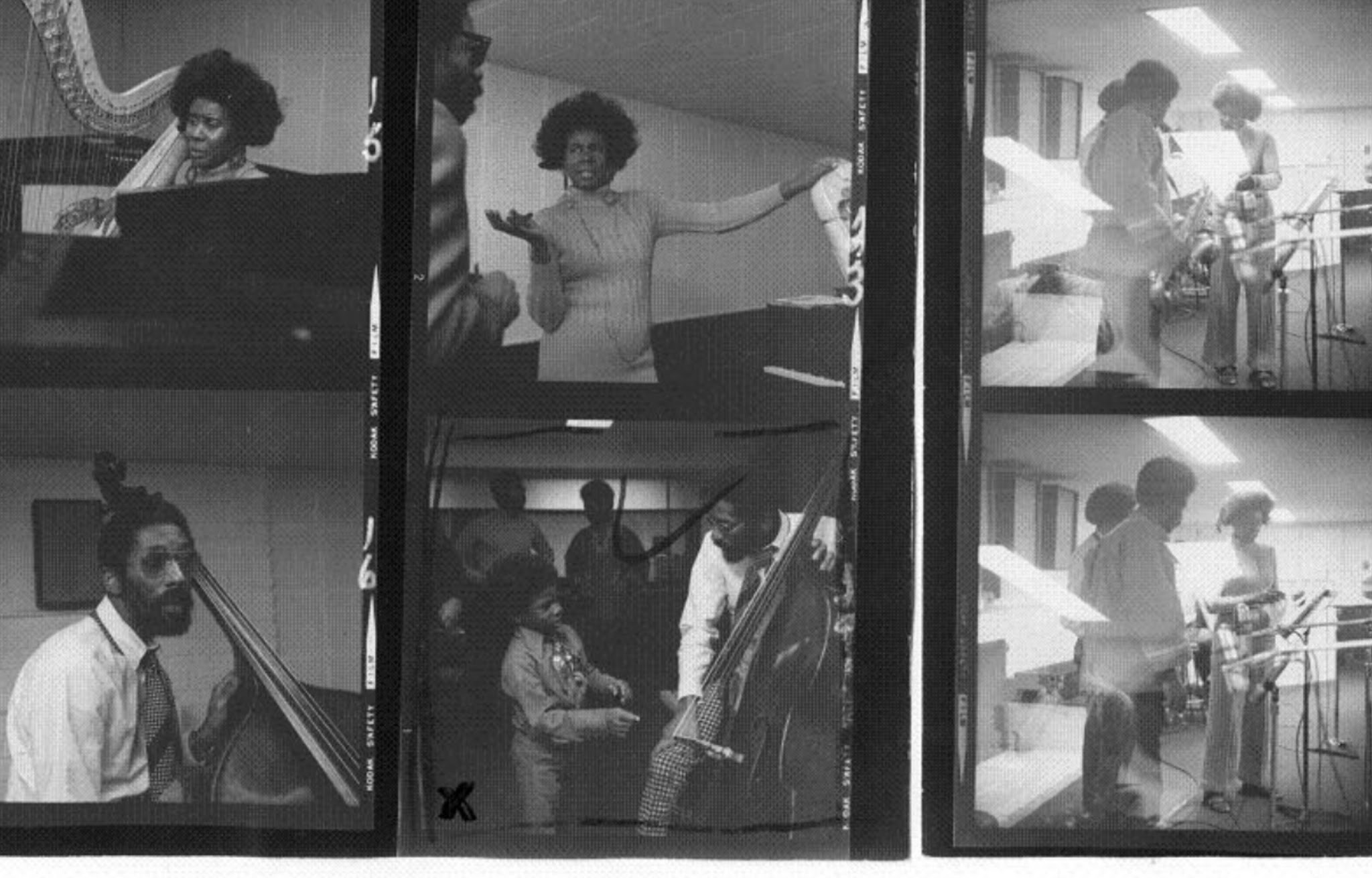
Fig. 3. Chuck Stewart, contact sheet, Ptah, the El Daoud session, Coltrane Studios, January 1970. Courtesy of the Hammer Museum.
Alice’s determination is palpable throughout Stewart’s contact sheets. Taken together, the squares on the contact sheets comprise a record of simultaneity, a tapestry of Alice’s roles managing family and directing musical collaborators, in between recording her own takes.
For a Black woman and a widowed mother in the late 1960s, the making of a home studio was both a creative necessity and a political act. It meant she did not have to negotiate access to a room, or work according to someone else’s schedule. She could bend time to her will, calling her husband’s sound back into the room on a four-track. The life she was building — art beside children, work beside grief — could take the shape she chose, rather than one imposed on her.
“I don’t want to work in clubs,” Alice said in 1968. “There’s nothing I like better than being with my kids in my home. This is it for me.”
-Lauren Du Graf
June 2026
Lauren Du Graf is a writer whose work spans film, music, philosophy, and literature, including the Grammy-nominated, ASCAP Award–winning liner notes for Alice Coltrane: The Carnegie Hall Concert. She earned her PhD in English and Comparative Literature from the University of North Carolina at Chapel Hill.
RELATED ARTICLES